Saturday, 29 August 2026

THE GEOMETRY OF MAJORITY: Math, Privilege, and Constitutional Supremacy in Sierra Leone


THE POLITICS OF FRACTIONS: The 97-Vote Dilemma: Constitutional Supremacy,  Injunctions, and the Battle for Sierra Leone’s Democracy.

By Israel Ojekeh Parper Snr. 17/08/2026

1. Introduction: 
Can a fraction of a human vote alter the supreme law of a nation? This is the central question driving the current constitutional crisis in Sierra Leone. Following the dramatic passage of the highly contested Constitution of Sierra Leone (Amendment) Bill, 2025 on 10 August 2026, the nation's political landscape has locked into a fierce procedural and legal battle.
The crisis centers on two distinct but deeply connected dilemmas. The first is a mathematical and procedural dispute: what exactly constitutes a "not less than two-thirds" majority in a 149-seat parliament, and can it be bypassed during a Third Reading using voice votes? The second is a jurisdictional battle: can the Speaker of Parliament use internal rules to shield legislative voting methods from judicial review? 
This article explores the legal fiction of rounding human votes, analyses the strategic maneuvers behind the opposition walkout and the ruling party’s response. It breaks down the statutory clash between Parliamentary Privilege and Constitutional Supremacy by examining global Commonwealth precedents to project how the Supreme Court of Sierra Leone must resolve this ugly standoff and details historical Sierra Leone cases, including the 2002 APC v. Speaker of Parliament precedent, and outlines why Constitutional Supremacy must ultimately triumph over Parliamentary Privilege.
2. The Indivisibility of the Sovereign Vote (The Math Argument)
THE 2/3RD MATHEMATICAL THRESHOLD 
     Total Seats: 149.  Exact 2/3rds Calculation: 99.333...
     [99 Votes] = 66.44% ◄ FAILS ("Less than" 2/3rds) requirement.
     [100 Votes] = 67.11% ◄ PASSES ("Not less than" 2/3rds) requirement.
The text of Section 108 of the 1991 Constitution mandates a threshold of “not less than two-thirds” of all Members of Parliament for a constitutional amendment. In a 149-seat house, this calculation yields an exact figure of 99.33.
While daily commerce and standard statistical methods round down decimals, .5, constitutional jurisprudence treats human votes as completely indivisible. A fraction of an MP cannot cast a ballot: The "Whole Human" Rule. However, when applied to human beings in a constitutional context, this practice fails both logically and legally. The Threshold Test: Recording 99 votes yields exactly 66.44% of the total House membership. Because 66.44% is mathematically less than the constitutional floor of 66.66% (two-thirds), a tally of 99 votes will represent a structural failure to meet the mandatory threshold.
To satisfy the minimum requirement defined as "not less than," the Safety Margin is to round up to the next full human being. Therefore, any vote tally below 100 votes fails to meet the strict legal threshold required to alter the Constitution. The 97 votes obtained by the ruling government under the Speaker's purview, following the opposition walkout, fell short of this absolute minimum. 
3. The Third Reading Deception
The procedural handling of the bill exacerbated the mathematical failure. The opposition All People’s Congress (APC) engaged in the committee stage under the strict understanding that the entire process was governed by the rigorous standard of Section 108, which requires a supermajority vote at both the Second and Third Readings. Some of the clause-by-clause amendments were rooted both under sections 91(1) - procedural issues, and under section 108(2) and (3) - constitutional issues for which the strict 2/3rd majority (and referendum) requirements are required. The Speaker called the vote therein on a simple majority of 97 to 46, and that prompted the walkout. 
Then, at the critical Third Reading, Speaker Segepoh Solomon Thomas shifted the goalposts. Rather than conducting a formal counted vote to prove the 100-vote threshold was met, the Speaker pushed the bill through via voice votes, declaring a result of 97 to 0. By relying on a simple majority of those left in the hall under Section 91(1) rather than a comprehensive vote of the whole house under Section 108(2)(b), the procedural sanctity of the amendment was fundamentally broken. Therefore, the bill was passed unconstitutionally.
4. The Walkout by APC MPs and the Speaker’s Gambit: Strategy or Blunder?      
The dramatic exit of the APC MPs followed a lengthy monologue by the Speaker, who used his position to justify the lower voting threshold at the committee stage, raising critical questions about political and procedural strategy. 
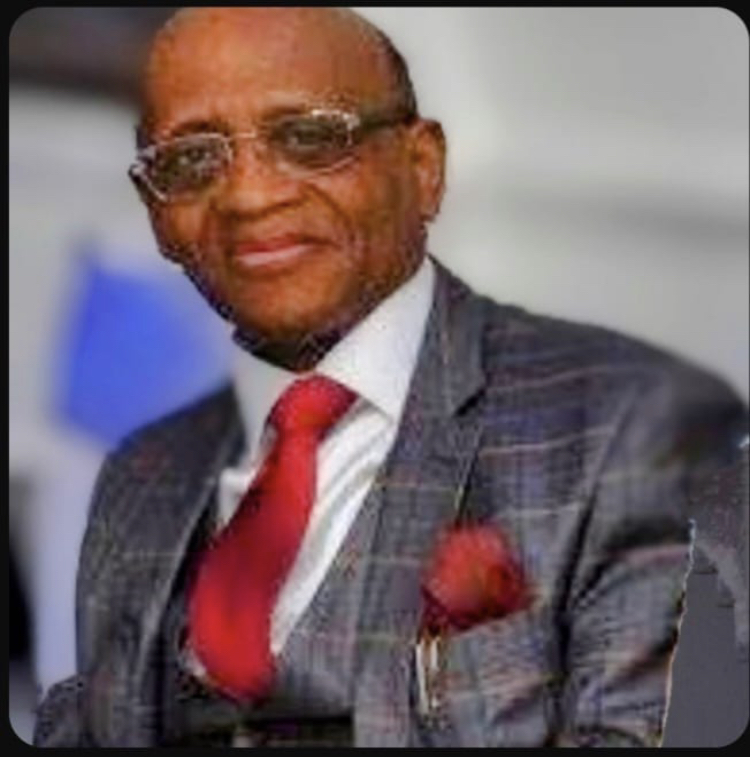
                                                                                                                   Hon. Abdul Kargbo 
                                                                                                                                            (Leader of the Opposition in Parliament)
Was the Opposition Walkout Prudent?
Politically, the walkout was designed to strip the session of democratic legitimacy and signal a clear constitutional protest to the public and the international community. However, procedurally, it was a high-stakes gamble. 
If the APC had chosen to stay, sit in their seats, and vote "No" (or even formally abstain), their 46 votes would have brought the total recorded numbers in the room to 143 (97 ruling party + 46 opposition). Had they done this: 
  • The Speaker’s reliance on a simple majority voice vote might have been completely disrupted, forcing a divided, counted division.
  • The raw data would have explicitly proven that 97 votes were cast against 46, visibly falling short of the 100-vote constitutional requirement in a fully attended house. 
By walking out, the APC left an empty chamber, inadvertently allowing the ruling party to manufacture an artificial consensus of "97 present, 0 opposed,"  giving the Speaker then used this gap to his advantage and claimed a unanimous vote among those present, ignoring section 108 compulsory mandate.
5. The Ruling Party’s Strategy: Hiding Behind Section 94(2)
The ruling party’s strategy was highly calculated. By fast-tracking the bill through a simple majority and immediately plastering the Parliamentary Facebook Page with declarations that "THE SPEAKER'S RULING IS FINAL AND CANNOT BE CHALLENGED IN ANY COURT OF LAW," the parliamentary leadership attempted to construct a legal fortress. They relied strictly on Section 94(2), which protects Parliament's right to manage its internal rules. 
  THE SPEAKER'S DEFENSIVE SHIELD under Section 94(2): "Internal Economy" - Dictates daily debates; Rules on points of order; now attempts to block the courts.
EXAMINING CRACKS WHEN A CONSTITUTIONAL THRESHOLD IS BREACHED falls under Section 124: "Judicial Supremacy" - the court reviews total vote counts and strikes down invalid laws passed by Parliament.
So, Why Did the Speaker Reference the Supreme Court?
If the Speaker truly believed his ruling was final and absolute, his simultaneous decision to refer the matter to the Supreme Court for an opinion within three months appears deeply contradictory and troublesome. This conning move reveals a calculated game plan rather than genuine confusion: 
  1. Shifting Political Blame: By sending the issue to the judiciary, the Speaker temporarily deflected immediate public and political outrage from the Parliamentary podium. Creating a "Fait Accompli": It allowed the executive branch to print and gazette the bill into law immediately, changing the electoral rules for the upcoming elections while the court system slowly processed the reference. 
  2. The Ultimate Paradox: The Speaker attempted to use the Supreme Court as a legal consultant to validate his actions, while simultaneously claiming the court lacked the jurisdiction to invalidate his final authority. This, in my humble opinion, is simply a poor attempt to constrict the Supreme Court to reach a decision that might equal his preferred outcome. 
6. Checkmating the "Fait Accompli": The Power of Interlocutory                Injunctions
The executive branch routinely tries to beat the legal clock by rapidly signing, printing, and gazetting a disputed bill into law. (So far, President Maada Bio has not yet signed this amendment bill, which has generated a huge backlash and calls on the President not to sign it.) This hurried strategy normally creates an artificial reality—a fait accompli — forcing the courts to deal with an active Act of Parliament rather than a pending bill. However, the 1991 Constitution and established common law provide citizens with a powerful shield against these fast-moving maneuvers: the "interlocutory injunction".
Under Section 124(1) of the 1991 Constitution, any citizen or political entity has direct standing (locus standi) to file an urgent emergency application to the Supreme Court alongside their substantive lawsuit. Section 124(1) of the 1991 Constitution, any citizen has the standing to approach the Supreme Court if they believe a provision of the Constitution has been manipulated, exceeded, or broken. The APC, as a political entity, or its individual MPs, possess direct standing to sue.   By naming the Government Printer, the Clerk of Parliament, and the Attorney-General, an injunction can legally freeze the bill in its tracks. This emergency brake prevents the state from publishing the bill in the official Gazette until the Supreme Court rules on the 97 vs. 100 vote tally.
The Legal Balance: Why the Courts Must Freeze the Bill
To successfully secure this injunction, applicants do not need to prove their entire case immediately. They only need to meet the standard three-part legal test applied by Sierra Leonean courts:
  1. A Serious Question to be Tried: Proving that the 97-vote margin falls short of the 99.33 threshold easily demonstrates a major, legitimate constitutional question.
  2. Irreparable Injury: Allowing an invalid electoral law to be gazetted causes immediate, irreversible damage. It disrupts the operations of political parties and the Electoral Commission. A late court ruling cannot easily undo this chaos if election planning is moving or has already moved forward.
  3. The Balance of Convenience: The state suffers no permanent harm by waiting for a clear Supreme Court ruling. Conversely, the democratic fabric of the nation suffers immensely if an unconstitutional amendment is allowed to take effect.
As established by the historic decision of Appeal Court Justices Tolla Thompson, Abel Stronge, and Patricia Macaulay, the judiciary’s duty to protect the Constitution includes the absolute power to freeze rushed administrative actions that attempt to bypass judicial review.
7. The Supremacy of Section 124 over Section 94(2) (The Jurisdictional Argument)
         
The mathematical failure has sparked an even deeper institutional crisis. Following public backlash, statements from the Parliamentary Office claimed that the Speaker's ruling on the voting method was final and is completely immune to outside legal challenges by any court. This assertion sets up a direct confrontation between two powerful sections of the 1991 Constitution. It is a misinterpretation of the relationship between Parliamentary Privilege and Constitutional Supremacy.
The Speaker's position is governed by Section 94(2), which grants Parliament the power to regulate its "internal economy"— that means, Parliament has the exclusive right to regulate its own internal procedures,- i.e., everyday debates, scheduling, and standard points of order. The logic is that courts should not meddle in daily legislative debates, house management, or points of order. However, this internal authority cannot shield an action that breaks a mandatory constitutional requirement.
The judicial position is governed by Section 124(1), which grants the Supreme Court original and exclusive jurisdiction over the enforcement and interpretation of the Constitution. It empowers the judiciary exclusively to determine whether any act passed by Parliament exceeds its legal powers exceeds its legal powers.
When a voting threshold is missed, it ceases to be a minor procedural issue and becomes a structural violation of the supreme law. As established by the landmark 2002 APC v. Speaker precedent (decided by the authoritative bench of Justices Tolla Thompson, Abel Stronge, and Patricia Macaulay), the judiciary has a duty to intervene when Parliament violates mandatory constitutional rules. Under Sierra Leonean law, the Speaker rules the House, but the Constitution rules the Speaker. The Constitution is Supreme; Parliament is not!

8. The Hierarchy of Law: Commonwealth Precedents
When an internal parliamentary rule clashes with a mandatory constitutional threshold, global Commonwealth jurisprudence (which is persuasive) is clear: Constitutional Supremacy always wins.
 THE SUPREMACY HIERARCHY 
 Level 1: The Constitution - (Enforced by the Supreme Court) - Overrules or approves. 
 Level 2: Parliament Rules - (Managed by the Speaker's Fiat).
If the Speaker makes a bad call on a standard debate amendment, his ruling is final under Section 94(2). However, if the Speaker declares a Constitutional Amendment Bill passed using 97 votes instead of the required 100, he is not just managing internal procedure. He is altering the state's supreme law. 
Under Section 124, the Supreme Court has the ultimate authority to step in. It can review the vote tally and declare the passing of the bill unconstitutional and void. The Constitution is supreme; Parliament is not supreme. Courts across the Commonwealth have repeatedly ruled that the Speaker’s gavel cannot be used to bypass constitutional boundaries.
9. Sierra Leonean Precedent
  • The Tolla Thompson, Abel Stronge and Patricia Macaulay Bench-- Appeal Court of Sierra Leone 2002: The Supreme Court of Sierra Leone previously addressed the limits of Section 94(2). The bench firmly rejected the idea that the judiciary cannot review the actions of the Speaker. The court ruled that if Parliament breaches a mandatory provision of the Constitution, the judiciary has a duty to intervene.
APC v. Speaker (2002)
The claim that the Speaker's gavel is untouchable by the courts is directly debunked by Sierra Leone's own constitutional history.  During the SLPP administration of President Ahmad Tejan Kabbah, with the formidable Solomon Berewa serving as Attorney General, a highly parallel crisis emerged in 2002. The APC opposition filed a historic lawsuit against the Speaker of Parliament (APC v. Speaker of Parliament, 2002), challenging internal parliamentary maneuvers and rulings that they argued circumvented constitutional rules. 
In that landmark era, the state tried to hide behind the exact same shield: arguing that parliamentary privilege and the Speaker's internal authority over the House were absolute and beyond the reach of judicial intervention.  The Court of Appeal forcefully shattered this defense. This historic judgment established two permanent pillars of Sierra Leonean law: 
  1. The Intervention Trigger: While the courts will not interfere in the standard, minor daily running of Parliament, they have an absolute duty to intervene the moment Parliament’s internal actions conflict with mandatory constitutional mandates. 
  2. The Subordinate Legislature: Parliament is a creature of the Constitution. Therefore, no internal rule of procedure created under Section 94(2) can be used to alter, diminish, or bypass an explicit voting threshold set by the supreme framework of the nation. 
West African Precedent
  • Attorney General of Bendel State v. AG of the Federation (1981) - Nigeria: The Nigerian Supreme Court voided an Act of the National Assembly because Parliament failed to follow the voting procedures set by th e Constitution. The court clarified that parliamentary privilege cannot be used to hide a structural violation of supreme law.
  • Yeboah v. JH Mensah (1998) - Ghana: The Ghanaian Supreme Court affirmed that its enforcement powers are absolute. Internal parliamentary decisions cannot shield unconstitutional acts from judicial review.
East & Southern African Precedent
The South African Constitutional Court has similarly treated supermajority
requirements as part of the constitutional safeguards surrounding constitutional
alteration:
  • Speaker of the National Assembly v. De Lille (1999) - South Africa: The South African Court of Appeal delivered a landmark ruling on this issue. The court stated that Parliament is a creature of the Constitution. Therefore, all its actions and rulings are subject to constitutional review.
  •  Also see Certification of the Constitution of the Republic of South Africa
    1996 [1996] ZACC 26 and Matatiele Municipality & Others v President of the
    Republic of South Africa & Others (2) [2006] ZACC 12.
  • In Justus Kariuki Mate v. Wambora (2014) - Kenya: The Kenyan courts rejected a Speaker's claim of total immunity, ruling that judicial review is fully applicable if internal legislative processes violate constitutional rights or statutory thresholds.
Also in Kenya, the Supreme Court of Kenya considered the constitutional architecture governing constitutional amendment and emphasised the special character of the prescribed amendment requirements. See. Attorney General & 2 Others v Ndii & 79 Others [2022] KESC 8, 

The Ugandan Supreme Court took a stricter action in the case of  Attorney General v Ssemogerere & Olum [2005] UGSC 29, where the Court held that the constitutional requirement of a two-thirds majority of all Members of Parliament and stressed the necessity of complying with the constitutionally prescribed amendment procedure.

The United Kingdom
  • The Traditional Westminster Rule (Bradlaugh v. Gossett, 1884): Historically, the UK established that courts would not interfere with the internal affairs of Parliament. However, the UK operates under Parliamentary Sovereignty because it lacks a single, codified written constitution. 
  • The Modern Shift (R v. Chaytor, 2010): Even in the UK, the Supreme Court has clarified that parliamentary privilege has limits. It does not apply to actions that fall outside the core law-making functions of the House.
  • R v Judge of City of London Court [1892] 1 QB 273- Lord Esher MR  - the Literal Rule: “If the words of an Act are clear, courts must follow them even if it leads to manifest absurdity”.

Global Commonwealth (Canada, Australia, & Caribbean)
  • Canada (Harvey v. New Brunswick, 1996): The Supreme Court of Canada ruled that while parliamentary privilege is important, it cannot be used to bypass the Canadian Charter of Rights and Freedoms.
  • The Caribbean (Collymore v. Attorney General, 1967 - Trinidad and Tobago): This foundational case established that the courts have a duty to ensure the legislature acts within the boundaries of the constitution. Any legislative act that breaches these boundaries is void.

These Commonwealth cases are persuasive authorities that add weight to our own supreme judicial decisions and are in line with other constitutional juristic principles. They affirm that where a Constitution prescribes a special threshold for its alteration, or amendment, that
threshold must be strictly adhered to and given its full constitutional effect.

10. The Three-Step Deception
The strategy used by the ruling party and the Speaker follows a clear, calculated playbook designed to sideline the opposition and fast-track controversial electoral changes:
  • Step 1: The Bait-and-Switch: The opposition All People’s Congress (APC) joined the committee stage under the clear understanding that the entire process was bound by Section 108, which requires a strict two-thirds supermajority (100 votes) at both the Second and Third Readings.
  • Step 2: The Monologue and Walkout: Following a lengthy monologue by the Speaker to justify a lower voting threshold, the opposition walked out in protest. The Speaker immediately seized this moment. He shifted the goalposts by abandoning counted votes and relying on simple majority voice votes (97 to 0) under Section 91.
  • Step 3: The Facebook Dictum: Minutes later, Parliament’s official Facebook page declared that the Speaker's ruling was final and immune to court challenges under Section 94(2).
The Advisory Referral Game Plan
The Speaker’s decision to refer his own actions to the Supreme Court for an advisory opinion within three months is not a sign of confusion. It is a calculated stalling tactic.
By sending the issue to the judiciary while simultaneously claiming the courts have no power to overrule him, the Speaker attempted to pull off a legal illusion. The goal is simple: tie up the opposition in a slow-moving, three-month court process while the executive branch quickly prints, serialises, and gazettes the bill into law. By the time the court steps in, the government hopes to present the new electoral rules as an unalterable reality ahead of the 2028 elections.
11. Hitting the Emergency Brake
The APC and ordinary citizens do not have to sit idly by and watch this legal clock run out. The law provides an explicit counter-strategy to defeat these fast-moving tricks: the interlocutory injunction.
By aggressively filing for an urgent injunction against the Government Printer and the Attorney General, the opposition can completely stall the state machine. This legal action forces a freeze on the publication of the bill, rendering it completely inactive.
The historic 2002 APC v. Speaker case—decided by the authoritative bench of Justices Tolla Thompson, Abel Stronge, and Patricia Macaulay—clearly established that the Speaker's gavel cannot shield constitutional violations from judicial review.
The government's fast-moving tricks can, and should, be halted. The opposition must use the emergency brake of the courts to prove that while the Speaker may control the daily schedule of Parliament, he can never outrun the Constitution.

12. Conclusion: Final Arbiter - The Constitution is Master of Parliament.

The political narrative published on the Parliament’s Facebook Page is an outdated concept of absolute Parliamentary Sovereignty that does not exist under a written constitution. 
This claim that a Speaker's ruling on a constitutional amendment is final and immune to court challenges is legally unsupported in a modern democracy, as we have seen from the cases mentioned above.
While the Speaker maintains total authority over ordinary internal House procedures, that power ends the moment a constitutional threshold is breached.  He does not possess the power to rewrite mathematics. Lowering a mandatory supermajority from 100 votes to 97 votes through an alternative interpretation of the quorum is not only a minor procedural choice - it is a structural alteration of the state's supreme framework. 
In a system based on constitutional supremacy, Section 124 overrides Section 94(2) when a constitutional threshold is violated. The Speaker rules over parliamentary procedure as stated above, but the Supreme Court rules over the Constitution. As established by the 2002 APC v. Speaker precedent, the judiciary holds the ultimate map of power. The Supreme Court of Sierra Leone holds the ultimate authority to resolve this crisis. Armed with Section 124, backed by solid domestic and Commonwealth precedents, the Supreme Court of Sierra Leone, having been dragged into this dispute by the Speaker, must now step forward and apply the Rule of Law. Its upcoming ruling must firmly remind the legislative branch of a timeless democratic truth and reinforce its constitutional authority entrenched under section 124. PRESIDENT JULIUS MAADA BIO MUST NOT ASSENT TO THIS BILL SO IRREGULARLY PASSED, BUT MUST RETURN IT TO PARLIAMENT FOR FURTHER SCRUTINY, FOR PEACE AND PROPER ORDER
Parliament is master of its own House, but the Constitution remains master of Parliament. The Speaker rules the House, but the Constitution rules the Speaker.
Relevant rules of interpretation: Leteral and Purposive- MELRON Nicol Wilson writes to Speaker - passed bill is unconstitutional 
Click Link

Michael Imran Kanu 


--------------------------------------------------------------------


APPENDIX & OTHER COMMENTARIES


Changes in the constitution explained 


Saturday, 15 August 2026

SIERRA LEONE 1991 - 2026 CONSTITUTIONAL REFORMS: PART 3: THE LEGISLATIVE DRAMA: FROM SECOND READING TO THE APC WALKOUT


Legislative Drama: From Second Reading to the APC Walkout

 (By Israel Ojekeh Parper Snr. 15th August 2026)

Executive Summary

Part III examines the decisive parliamentary phase of Sierra Leone’s 2026 Constitutional Amendment Bill, tracing the journey from the Second Reading through the Committee Stage and culminating in the dramatic APC walkout. Although the substantive reforms—such as the 50%+1 presidential threshold, proportional representation, dual citizenship eligibility, women’s leadership quotas, and district distribution requirements—were broadly understood and long‑debated, the real confrontation emerged over procedure, not content, although there were strong doubts and dissatisfaction on the opposition side.

The core dispute centred on the interpretation of Section 91(1) (simple majority rule) versus Section 108 (two‑thirds safeguard for entrenched provisions). The Speaker ruled that clause‑by‑clause voting during Committee Stage could proceed under Section 91(1), while the APC insisted that all constitutional amendments must follow the stricter Section 108 requirements. This disagreement hardened during Committee deliberations and reached its peak when the Speaker upheld the simple‑majority threshold, resulting in a 97–46 vote and the subsequent APC walkout.

Despite the walkout, quorum was maintained, and the Bill proceeded to Third Reading, where it supposedly passed with a VOICE VOTING CALL, with SLPP MPs, Paramount Chiefs, and two remaining APC MPs. The Speaker then took the unprecedented step of referring the procedural dispute to the Supreme Court, recognising that the threshold question had become a constitutional matter requiring judicial interpretation.

Part III therefore captures the moment when a legislative process transformed into a constitutional test case—highlighting the tension between parliamentary discretion and constitutional safeguards, and setting the stage for judicial review.


The Procedural Fault‑Lines That Shaped the 2026 Amendment’s Final Hours

The journey from Second Reading to so-called passage of the 2026 Constitutional Amendment Bill was not merely legislative choreography; it was a stress test of Sierra Leone’s constitutional procedures, exposing ambiguities in Section 91(1) (voting thresholds) and Section 108 (amendment procedures). These ambiguities—long dormant—became the centre of political confrontation.

1. The Second Reading: Consensus on Substance, Division on Procedure

At Second Reading, MPs broadly agreed on the substantive reforms—50%+1 threshold, PR retention, dual citizenship eligibility, women’s quota, District distribution rule. But the procedural question emerged early:

  • Was a simple majority sufficient for passage?

  • Or did the Bill’s mixed content trigger Section 108 (2) and (3) (entrenched provisions requiring a two-thirds majority or referendum)?

The government argued that the Bill carefully avoided entrenched clauses, making it a non‑entrenched amendment requiring only a simple majority under Section 91(1). Opposition MPs insisted that several provisions “touched the architecture” of entrenched sections, thereby requiring a two‑thirds majority or referendum.

This disagreement set the stage for the Committee Stage confrontation. The Bill then passed to the Committee Stage, with this overhanging cloud.

2. Committee Stage: The Threshold Dispute Hardens

During Committee deliberations, the Attorney General’s team repeatedly emphasised that:

  • The Bill was drafted to avoid Section 108(2) and 108(3) triggers even though significant clauses functionally changed the constitution.

  • Every clause, he claimed, fell within the non‑entrenched zone

  • Therefore, Section 91(1) (simple majority) governed the voting process.

Opposition members countered that:

  • The electoral system, presidential qualification rules, and district distribution requirements were “functionally entrenched,” even if not textually entrenched.

  • Therefore, the Bill’s cumulative effect amounted to a structural alteration of the constitution; therefore, the appropriate voting process lies with section 108.

This disagreement hardened into a procedural standoff.

3. The 97–46 Vote and the APC Walkout

The decisive moment came when the Speaker Segepoh Soloman Thomas called the vote on the procedural question. The tally: 97 in favour, 46 against. But before announcing he would apply section 91(1), Mr Speaker delved into a monologue of a lecture, skipping from one section of the Constitution to another, back and forth, pin-pointing exceptions to the section 91 general rule in effect and announced the tally, based on a simple majority basis though in the process, he did mention more than once, that the second and Thir Readings require two-thirds majority (under section 108)

The Opposition MPs protested that the vote itself was premature; The Speaker had misapplied Section 91(1). The Bill required a supermajority or referendum under section 108.

When the Speaker upheld this simple‑majority interpretation, the APC Leader in Parliament,

Hon. Abdul Kargbo addressed the Speaker, called on all the Opposition members, and staged a walkout, leaving only two rebel APC MPs in the chamber as they could not be a party to such unconstitutional abrogation.

This walkout was not symbolic—it was strategic: It denied the government the optics of bipartisan passage which the Speaker was desperate to display; It preserved the APC’s legal argument for future challenges; and it framed the Bill as procedurally contaminated, regardless of its substantive merits.

4. Third Reading: Passage Without the Main Opposition

With the APC absent, the Third Reading proceeded swiftly with the Speaker conducting a VOICE VOTE with only 97 MPs present and blindly applying the same simple majority voting process.

The Speaker then ruled the Bill passed with only SLPP MPs, Paramount Chief MPs, and the TWO rebel members of the APC, Mohamed Bangura and Alfred Ayodele Thompson.

The Speaker then took an unprecedented step: he referred the procedural dispute to the Supreme Court, requesting constitutional interpretation of: Section 91(1) — Does “votes of the majority of members present and voting” apply to constitutional amendments? Section 108 — Can Parliament pass a constitutional amendment without referendum if the Bill avoids entrenched clauses? The legality of the 97–46 vote. The validity of the Third Reading conducted after the walkout

This referral transformed a political dispute into a constitutional question of first impression. Was the Speaker sure of what he was doing in the Committee stage and Third Reading? Has he blundered? Why did the Speaker not stay proceedings, seek clarification from the Supreme Court first, and then proceed with the Third Reading based on the Supreme Court's opinion or ruling?


CONCLUSION 

From Parliamentary Conflict to Constitutional Clarification

The events of Part III reveal a Parliament navigating both political tension and constitutional ambiguity. What began as a routine legislative process evolved into a confrontation over the very architecture of constitutional amendment procedure. The Speaker’s reliance on Section 91(1), the APC’s insistence on Section 108, and the dramatic walkout collectively exposed long‑standing uncertainties in Sierra Leone’s amendment framework.

Yet the Speaker’s final act—referring the matter to the Supreme Court—shifted the dispute from the political arena to the judicial domain. This referral acknowledges that the question at hand is not merely procedural but foundational: How should Sierra Leone interpret the relationship between general voting rules and entrenched constitutional safeguards?


Appendix.

Section 91 vs Section 108 — Part III .


═══════════════════════════════════════════════════════════════════════
🎀  SECTION 91 vs SECTION 108 — PROVISION OVERVIEW.
═══════════════════════════════════════════════════════════════════════

🟦SECTIONS INVOLVED
───────────────────────────────────────────────────────────────────────
🔵 Section 91(1) → General voting rule → Simple majority  
🟣 Section 108   → Constitutional safeguard → Two‑thirds majority

═══════════════════════════════════════════════════════════════════════

🟩 TYPE OF RULE
───────────────────────────────────────────────────────────────────────
🟢 General Parliamentary Rule → Ordinary decisions + Committee Stage  
🟣 Amendment Safeguard → Second & Third Readings of amendment bills

═══════════════════════════════════════════════════════════════════════

🟧  THRESHOLD REQUIREMENTS
───────────────────────────────────────────────────────────────────────
🟠 Ordinary Decisions → Simple majority (50% + 1)  
🔴 Entrenched Provisions → Two‑thirds of ALL MPs

═══════════════════════════════════════════════════════════════════════

🟪  APPLICATION OF RULES
───────────────────────────────────────────────────────────────────────
🔵 Section 91(1) → Applies to ordinary votes + clause‑by‑clause  
🟣 Section 108   → Applies to constitutional amendments (2nd & 3rd Reading)

═══════════════════════════════════════════════════════════════════════

🟨 GOVERNMENT POSITION
───────────────────────────────────────────────────────────────────────
🟡 Clause votes = Section 91(1)  
🟡 Section 108 only triggered if entrenched provisions are touched  
🟡 Simple majority valid unless entrenched clauses involved

═══════════════════════════════════════════════════════════════════════

🟥 APC POSITION
───────────────────────────────────────────────────────────────────────
🔴 Section 108 cannot be overridden  
🔴 ALL constitutional amendments require two‑thirds  
🔴 Clause segmentation does NOT remove the safeguard

═══════════════════════════════════════════════════════════════════════

🟦  ORIGIN OF DISPUTE
───────────────────────────────────────────────────────────────────────
🔵 Speaker used Section 91(1) → 97–46 vote  
🔴 APC insisted Section 108(2)(b) → two‑thirds required  
🟣 Disagreement → procedural conflict → APC walkout

═══════════════════════════════════════════════════════════════════════

🟪 SUPREME COURT QUESTIONS
───────────────────────────────────────────────────────────────────────
🟣 Can Section 91(1) govern amendment procedure?  
🟣 Did the Bill trigger Section 108?  
🟣 What threshold applies at Committee, Second, and Third Reading?  
🟣 Decision will shape future amendment processes.

═══════════════════════════════════════════════════════════════════════
🎀  
═══════════════════════════════════════════════════════════════════════
https://fb.watch/J0gH1pFaxy/


Israel Ojekeh Parper Snr.( Blogger/Publisher)

——————————————-

COMMENTS:

Aruna Bundu-Conteh.(FB Post).

This bogus so-called Speaker is absolutely wrong. The Supreme Court of Sierra Leone has the constitutional authority to interpret any constitutional provisions. Why did the Speaker say he would ask the Supreme Court for interpretation if he was so convinced that his Rulling was 'final'. ?? 🙄

The Speaker is absolutely 💯 wrong 🤐. According to Section 124 (1) of the Constitution of Sierra Leone Act No.6 of 1991, the Supreme Court shall have original jurisdiction: Section 124 (1) (a): In all matters relating to the enforcement or interpretation of any provision of the Constitution. Further, and significantly, according to Section 124 (1) (b), the Supreme Court has ORIGINAL JURISDICTION: Where any question arises whether an enactment "WAS MADE IN EXCESS OF THE POWERS CONFERRED UPON PARLIAMENT OR ANY OTHER AUTHORITY OR PERSON BY LAW OR UNDER THIS CONSTITUTION. " Thus, the legal implications of Section 124 (1) (b) is that, contrary to the disingenuous argument advanced by the Speaker, the Supreme Court has jurisdiction over this 2025 Bill which was made in excess of the powers (2/3 majority of votes by MPs) conferred upon this Parliament. Further, Section 122 (1) , even the President may refer a Petition in which he has to give a final decision, such as signing this 2025 Constitution Amendment Bill, to the Supreme Court "for a final opinion." By: Aruna Bundu-Conteh Esq: LLB (Hons) (London), LLM (London), PhD in Law (London), Barrister & Solicitor of the Supreme Court of Sierra Leone 🇸🇱

-------------------------------------------------------------------------

Constitutional Capture and the Unraveling of Democratic Order: Sierra Leone’s Guardians of Democracy Confront Their Defining Test as Media, Civil Society, Labour Unions, and Clergy Stand as the Republic’s Final Defense Line. | The Salone Independent Chronicle

Relevant Rules of Interpretation: Literal and Purposive

https://thecalabashnewspaper.com/archives/63701


Friday, 31 July 2026

SIERRA LEONE 1991 - 2026 CONSTITUTIONAL REFORMS: PART 2: HISTORICAL LINEAGE

    The Thirty‑Year Constitutional Relay: How Generations of Failed Reviews Shaped the 2026 Reforms.

     By Israel Ojekeh Parper Snr. 31/07/2026


The Thirty‑Year Constitutional Relay: How Generations of Failed Reviews Shaped the 2026 Reforms

Tracing the lineage from Strasser’s 1993 Advisory Council to the Tucker and Cowan Commissions — and how Alpha Sesay “cloned” three decades of consensus.

EXECUTIVE SUMMARY

Sierra Leone’s 2026 Constitutional Amendment Bill is the latest chapter in a thirty‑year relay of reform attempts, each one producing ideas but failing procedurally. From the 1993–1995 Strasser Advisory Council, through the 2008 Tucker CRC, the 2017 Cowan CRC, and the 2023 Tripartite Committee, successive governments generated a remarkably stable body of consensus on electoral calendars, executive removal rules, depoliticization of the armed forces, and proportional representation.

Attorney General Alpha Sesay’s 2026 draft did not invent new doctrine; it consolidated, cloned, and operationalized the accumulated consensus of three decades. His procedural innovation — abandoning the “total overhaul” model in favour of targeted parliamentary amendments — finally allowed Sierra Leone to 

implement reforms that had been intellectually settled since the 1990s but politically blocked by referendum requirements, transitions of power, and institutional inertia.

Part II traces this lineage, showing how the 2026 reforms are not a rupture but the first successful harvest of Sierra Leone’s long‑standing constitutional aspirations.


INTRODUCTION: THE LONG ROAD TO REFORM!  Why Sierra Leone Keeps Returning to the Same Constitutional Questions.

Constitutional reform in Sierra Leone has never been a single event; it is a recurring national conversation that re‑emerges every decade with strikingly similar conclusions. The country’s constitutional history reads less like a sequence of isolated commissions and more like a continuous intellectual project, repeatedly interrupted by political transitions, crises, and shifting priorities.

From the NPRC’s 1993 Advisory Council to the Cowan CRC’s nationwide consultations, Sierra Leone has produced thousands of pages of recommendations, hundreds of stakeholder submissions, and multiple draft constitutions — yet until 2026, almost none of these proposals crossed the threshold into law.

This section examines the historical relay that shaped the 2026 reforms:

• how the 1995 Working Draft introduced modern governance concepts;

• how the Tucker CRC refined them with post‑war institutional logic;

• how the Cowan CRC validated them through mass public consultation;

• and how the Tripartite Committee gave them bipartisan legitimacy.

By tracing this lineage, we see that the 2026 Amendment Bill is not a sudden innovation but the culmination of a thirty‑year constitutional conversation — one that finally found a procedural pathway to implementation.

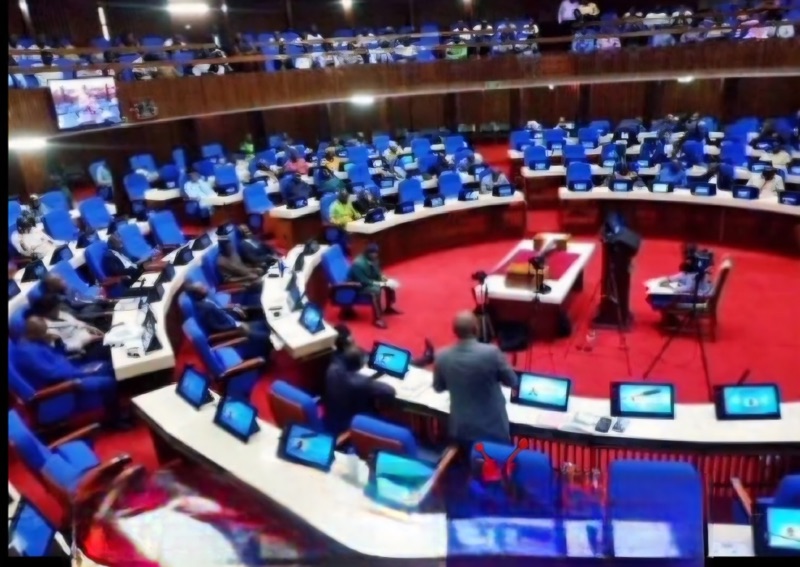
Sierra Leone’s House of Parliament 

THE CHAIN OF HISTORICAL REVIEW EFFORTS (1993–2023)

Sierra Leone’s modern constitutional journey passes through four major milestones before the currently debated efforts:

1. Strasser/ NPRC Advisory Council (1993–1995)

Following the 1992 coup, Capt. Valentine Strasser appointed Dr. Ahmad Tejan Kabbah to chair a National Advisory Council which produced the 1995 Draft Working Contitution. 
This 1995 Working Draft constitution -was never enacted, but it pioneered/introduced several modern debates such as:

• splitting the Attorney General from the Minister of Justice,
• demilitarisation politics and restricting military involvement in governance 
• early proposals for fixed election dates,
• early proportional representation concepts e.g. District-based proportional representation (PR) experiments.

Although abandoned after the 1996 democratic elections, it created the first modern reform blueprint.

2. The Dr Peter Tucker Constitutional Review Commission (2007–2008)
Appointed by President Tejan Kabba after the TRC’s recommendations, Dr. Peter Tucker led a technical commission that:

• identified structural gaps in the 1991 Constitution text, 
• proposed independent agency models,
• recommended fixed electoral calendars,
• highlighted entrenched clauses requiring referendum thresholds.

The report was submitted to the incoming Government in 2008 but the report was shelved due to political transition.

However, its technical precision later became the backbone of Justice Edmond Cowan’s (2013 - 2017) and the current Attorney General Alpha’s 2026 constitutional reviews.

3. Cowan Constitutional Review Committee (2013–2017)
President Ernest Bai Koroma launched an eighty (80) member plenary led by Justice Edmond Cowan. This was the largest civic consultation conducted in Sierra Leone’s history: it conducted over 10,000 public consultations nationwide, held about 133 stakeholder engagement;  received back over 70,000 consultation forms, and 150 position papers were submitted. 

The process culminated in a 2017 White Paper in which the government after scrutiny, rejected about 75% of recommendations, stalling the overhaul prior to the 2018 elections. 

However, the Cowan CRC produced a very comprehensive consensus archive which has been found useful by the current AG in his drive towards constitutional reform.

4. Tripartite Committee (2023)
Following the disputed 2023 General elections, the Government and the All Peoples Congress (APC) party 
formed  a Tripartite Committee that  produced 18 consensus recommendations, including:
district‑level PR mechanics, electoral calendar reforms, strengthened nomination processes for Electoral Commission and gender‑inclusive provisions.

This committee was supposed to provided the political legitimacy earlier reviews lacked, but there has been some  arguments and disagreements at its implementation.


1991 vs 1993–1995: TWO PATHS TO MULTIPARTYISM.

A comparison of the 1990 - 1991 President J S Momoh transition and the 1993 / 1995 Captain Valentine Strasser/Tejan Kabba transition reveal two distinct constitutional paradigms:

Dimension. 1990-1991   1993-1995
                      Momoh.       Strasser
                     Transition    Transition
            (Peter Tucker)  (Tejan Kabba)

Originating  Dejure       Defacto
Authority    Civilian      MilitaryJunta
                    Govt.
                   One-party    Junta-NPRC
                   state         

Primary                        
Mechanism. Top-down     Post coup                  
                  repeal of      exit roadmap 
                 1978                    &
                one-party       Advisory
                 state                 Council 
                                           drafting

Public                          
Consent  Enacted via     By passed;
                August 1991    1996
                Public               elections 
               Referendum     held under    
                                         restored        
                                         1991 
                                        Constitution 
                                         text.

Core Focus. 
               Restoring      Demilitarising                      
               multiparty        politics;
                Political          establishing
               competition    independent 
              under civilian   agency
                rule.                 models


These divergent origins explain why later commissions struggled: The 1991 Constitution headed by Dr Peter Tucker during President Momoh’s era, was born from a civilian referendum, while the 1995 draft by the Advisory Council headed by Tejan Kabba under NPRC,was born from a military exit strategy. Their DNA never aligned.

HOW ALPHA SESAY “CLONED” 30 YEARS OF CONSENSUS.


Attorney General Alpha Sesay rather than drafting new constitutional change concepts, adopted a strategic legislative harvesting process which he described in Parliament as “nothing invented in my office.” He as Attorney General has presented a government proposal to Parliament after systematically extracted, consolidated and re packaged thirty (30) tress of accumulated public and expert consensus. Every major provision in the 2026 Bill is a direct extraction from earlier national processes: a CUT AND PASTE EXERCISE!

TH CLONED LEGISLATIVE LINEAGE INCLUDES:

• Executive removal rules — lifted from Cowan (2017) which analysed the 2015 Sam‑Sumana crisis and proposed a clearer (VP) removal procedures; 
• Fixed election schedules — first drafted in the 1995 Working Constitution Draft   refined by Peter Tucker in 2008 and re-endorsed by Cowan in 2017.
• Depoliticisation of armed services — traces its exact phrasing from TRC Report (2004) and the Peter Tucker CRC  in 2008. 
• District PR mechanics —derived from the 1995 Advisory Council of Tejan Kabba and the 2023 Tripartite Committee recommendations. As true to his words the A G (Alpha Sesay) “Nothing was invented in [his] office “!

THE MISSING PIECE AND PROCEDURAL BREAKTHROUGH AFTER 30 YEARS FAILURE

The most important insight is procedural, not substantive. But why earlier reform efforts failed?

Earlier efforts failed because  previous approaches were attempts in  total constitutional overhaul, requiring referendum thresholds and political alignment that never materialised. For instance: 1995: No referendum; military exit overshadowed intended reforms. In 2008: Political transition from Tejan Kabba to Ernest Bai Koroma but the Tucker laid frozen and in 2017, government rejected 75% of Cowan’s recommendations. The 2018 - 2023 attempt met with electoral disputes which consumed the political bandwidth and also, Entrenched clauses required referendum thresholds the government avoided for economic and other reasons.

The current Attorney General Alpha Sesay’s innovation: A procedural hack: instead of attempting a total overhaul (which requires a referendum) Sesay:

• extracted non‑entrenched consensus provisions,
• package them into targeted parliamentary amendments,
• avoided referendum deadlock, and 
• implemented reforms early enough for 2028 electoral timelines. This point he repeated a number of of times in his presentation in Parliament. 
This procedural shift is considered a strategic breakthrough of the 2026 reforms.


CONCLUSION

The Philosophy of Continuity: Why should the 2026 Reformers Succeed Where Other Past Efforts Failed?

Constitutional reform is often imagined as rupture — a decisive break from the past. Sierra Leone’s experience suggests the opposite: durable reform emerges not from rapture, but from continuity.

If the 2026 Amendment Bill succeeds (partisanship aside) it will be because it does not attempt to reinvent the constitutional order. Instead, A.G. Alpha Sesay appears to have capitalised and treated the past three decades of review efforts as a repository of assumed national wisdom, and brinksmanship, accumulated through military transitions, democratic restorations, peace building processes, and electoral negotiations.

The deeper philosophical lesson is that constitutional change in Sierra Leone has always been conceptually easy but procedurally hard. The country has long agreed on the core reforms. What it lacked is a mechanism capable of translating consensus into law without triggering political deadlock or referendum paralysis; and it appears that A. G. Alpha Sesay’s approach of incremental amendments rather than total overhaul of the constitution, cunningly embodies such pragmatic philosophy that will encourage legislators/reformers to follow the path of least resistance, and not the path of greatest ambition. This rather is his recognition that constitutions evolve through accumulation, not revolution; through harvesting, not invention. 

The questions now are : Would the 2026 reforms mark a turning point in Sierra Leone’s constitutional journey and do these reforms if passed into law demonstrate that Sierra Leone’s constitutional future will be built not by discarding the past, but by finally implementing the past’s most enduring ideas for the benefit of her citizens?

If the answers to these questions are in the affirmative, then the 2026 reforms will be a turning point as they will demonstrate that Sierra Leone’s constitutional future will no longer be built by discarding the past, but by implementing the past’s most enduring ideas; and that country’s constitutional journey is not a story of repeated failures, but of long-term coherence - a relay in which each generation carries forward the same baton until one finally crosses the finish line.

Let’s look to the future as Parliament continues debating the 2026 Constitutional Reform Bill.


 Author: Israel Ojekeh Parper Snr
Blogger/Publisher - Governance       Observer 


————————————-

LATEST ON CONSTITUTIONAL AMENDMENTS 


🏛️🇸🇱 SIERRA LEONE'S 1991 CONSTITUTION AMENDED: PARLIAMENT APPROVES MAJOR ELECTORAL REFORMS

On 28th July 2026, Sierra Leone's Parliament passed significant amendments to the 1991 Constitution, introducing some of the most far-reaching electoral and governance reforms in the country's democratic history. These changes are expected to shape how future elections are conducted and how key public offices are filled.

Here are some of the major constitutional amendments approved by Parliament:

🗳️ 1. Presidential Election Threshold
Previously, a presidential candidate was required to secure 55% of the valid votes cast to be declared the winner. Under the new amendment, the threshold has been changed to 50% plus one vote (50% + 1).

📌 Example: If 100 valid votes are cast, a candidate must receive at least 51 votes to win outright.

🗳️ 2. Electoral System Changed to Proportional Representation (PR)

Parliament has approved the Proportional Representation (PR) electoral system, replacing the previous constituency-based system for the elections covered by the amendment. This marks a significant shift in Sierra Leone's electoral framework.

⚖️ 3. Removal of the President or Vice-President

Previously, the removal of a Vice-President could occur following dismissal from their political party and subsequent action by the President. The amended law now provides that the President or Vice-President can only be removed through a two-thirds majority vote in Parliament, strengthening parliamentary oversight.

🗳️ 4. Appointment of the Chief Electoral Commissioner
Under the previous system, the President appointed the Chief Electoral Commissioner after consultations with political parties and stakeholders. The new amendment establishes a Search and Nomination Committee, appointed by the President, to identify and recommend qualified candidates for the position.

📅 5. Fixed Date for General Elections

Instead of the President setting the election date, Sierra Leone will now have a fixed election date.

🗓️ General elections will be held on the second Saturday of November in every election year.

👩🏽‍⚖️ 6. Women's Representation

To promote gender inclusion, every registered political party must now ensure at least 30% representation of women among its parliamentary candidates.

🏛️ 7. Independent Presidential and Vice-Presidential Candidates

For the first time, independent (non-partisan) candidates who meet the legal requirements may contest for the offices of President and Vice-President.

📋 8. Resignation of Public Servants

Previously, public officers seeking elective office had to resign 12 months before an election. The amended Constitution reduces this period to 6 months before becoming eligible to contest.

⚖️ 9. Election Petition Timeline

The deadline for filing an election petition has been shortened from 7 days after the declaration of results to 3 days, encouraging a faster resolution of electoral disputes.

🌍 10. Dual Citizenship and Public Office

The Constitution has also revised the rules regarding dual citizens. Rather than imposing a blanket restriction, the amendment introduces specific conditions under which dual citizens may qualify to contest for public office.

🇸🇱 These constitutional amendments represent a landmark moment in Sierra Leone's democratic evolution and are expected to influence future elections, governance, and political participation across the country.

💬 What are your thoughts on these constitutional reforms?

 🤔 Which amendment do you believe will have the greatest impact on Sierra Leone's democracy? 

📢 Share your views respectfully in the comments, and don't forget to Like 👍, Comment 💬, and Share 🔄 to keep the conversation going.

Wednesday, 29 July 2026

SIERRA LEONE 1991–2026 CONSTITUTIONAL REFORMS

SIERRA LEONE CONSTITUTIONAL LAW & ELECTORAL ARCHITECTURE  FOCUS: 1991–2026 REFORMS.

{By Israel Ojekeh Parper Snr. 29-07-2026}


Executive Summary

This report examines Sierra Leone’s proposed 2026 constitutional reforms through three lenses: the bill’s legislative content, its historical roots in earlier review processes, and its implications for proportional representation. The central question is whether the bill offers a pragmatic route to near-term electoral and administrative reforms, or offers a long-term democratic value depending on how transparently entrenched constitutional questions—especially executive power, judicial independence, rights protections, and election management—are addressed in a future referendum process.


An in-depth analysis of the proposed constitutional overhaul, political party posturing, and the controversial procedural split between entrenched and non-entrenched 


Sierra Leone stands at a pivotal constitutional crossroads as Attorney General and Minister of Justice, Alpha Sesay, pilots the 2026 Constitutional Amendment Bill through Parliament. Originating from decades of post-conflict governance consultations—including the 1999 Lomé Peace Accord, the Truth and Reconciliation Commission (TRC), the 2017 Cowan Constitutional Review Committee (CRC) Report, and the recent post-2023 election Cross-Party Tripartite Committee—this bill represents the most ambitious attempt to modernize Sierra Leone's electoral and administrative framework since the restoration of multi-party democracy.


Anatomy of the 2026 Amendment Bill

The proposed legislation concentrates on recalibrating state institutions, codifying electoral rules, and mitigating institutional friction during transition cycles. The core provisions include:

• Fixed General Election Schedule: Establishes a permanent voting date on the second Saturday of November every fifth year, stripping the executive of the power to manipulate election timing for tactical advantage.

• Proportional Representation (PR) Codification: Institutionalizes the District Block PR system into the constitution to eliminate frequent, costly, and politically volatile localized by-elections.

• Presidential Threshold Adjustment: Adjusts the winning threshold for presidential elections from 55% to 50% + 1 vote, while introducing a geographic requirement requiring candidates to secure at least 20% of votes in two-thirds of voting districts to ensure a genuine nationwide mandate.

• Depoliticisation of Security Forces: Explicitly prohibits the Sierra Leone Police (SLP) and the Republic of Sierra Leone Armed Forces (RSLAF) from participating in partisan activities or promoting party interests.

• PPRC Party Deregistration Powers: Empowers the Political Parties Regulation Commission (PPRC) to deregister any political party that fails to secure a seat at either local or national levels across two consecutive general elections.

• Executive Membership Protection: Clarifies that a sitting President or Vice President cannot be stripped of executive office purely on the grounds of losing party membership or being expelled by party leadership - resolving a major constitutional ambiguity exposed during the 2015 Sam-Sumana crisis.


The Parliamentary Battlefield: SLPP vs. APC

The debate inside the Chamber reflects deep-seated political divisions. The ruling Sierra Leone People’s Party (SLPP) frames the bill as an essential, non-partisan modernisation package that lowers the administrative cost of democracy and enforces cross-party consensus reached during the Tripartite Committee deliberations. The government explicitly rejects the opposition fears of an executive power grab, emphasising that no third-term extensions are contemplated.


Conversely, the opposition All Peoples Congress (APC) maintains a stance of high scrutiny. The APC insists that any constitutional amendment must strictly reflect all 80 recommendations of the Tripartite Committee without selective omissions. Furthermore, opposition MPs express alarm over the PPRC's proposed deregistration powers, warning that regulatory oversight could be weaponised against opposition coalitions or emerging third parties. The APC also demands that the proposed Independent Search and Nomination Committee for Electoral Commissioners be insulated from executive influence to guarantee total commission neutrality.

CIVIL SOCIETY & MEDIA REACTION

Civil Society Organizations (CSOs) and the Sierra Leone Association of Journalists (SLAJ) have welcomed the fixed election dates and security neutrality clauses. SLAJ, however, expressed concern that standalone press freedom protections were omitted from the non-entrenched text. On gender equality, rights groups have strongly backed the bill's mandatory 30% quota for women in parliament and local councils sees this as a landmark victory for inclusive governance.

The Split: Entrenched vs. Non-Entrenched Clauses

A central point of debate is the AG Alpha Sesay’s strategic decision to split the constitutional review into two distinct procedural tracks: non-entrenched clauses (which require a two-thirds parliamentary vote under Section 108) and entrenched clauses (which require a national referendum).

Dangers of Postponing Entrenched Clauses:

While passing non-entrenched administrative fixes appears to provide immediate electoral clarity, indefinitely shelving entrenched clauses would likely create structural risks. Leaving executive appointing powers, judicial independence mechanics, and fundamental human rights unreviewed while tightening operational electoral rules, risks creating an asymmetric system where the executive retains imperial powers while the  while operational playing field is strictly constrained.


Two notable points:


1. Reaffirmation of Democratic Limits: 

The Minister of Information Chernor Bah and AG Alpha Sesay publicly reaffirmed that President Julius Maada Bio has explicitly ruled out any "third-term" presidential agenda, reassuring the public that the 2026 bill focuses strictly on non-entrenched electoral mechanics and national cohesion.


2. The "Search and Nomination Committee" Test Case: Civil society organizations (such as ILRAJ) have been actively scrutinizing executive appointments to the Electoral Commission (ECSL), calling on Parliament to enact the bill's proposed independent framework swiftly to eliminate political interference in commissioner appointments.


A question from a former female Police Officer 


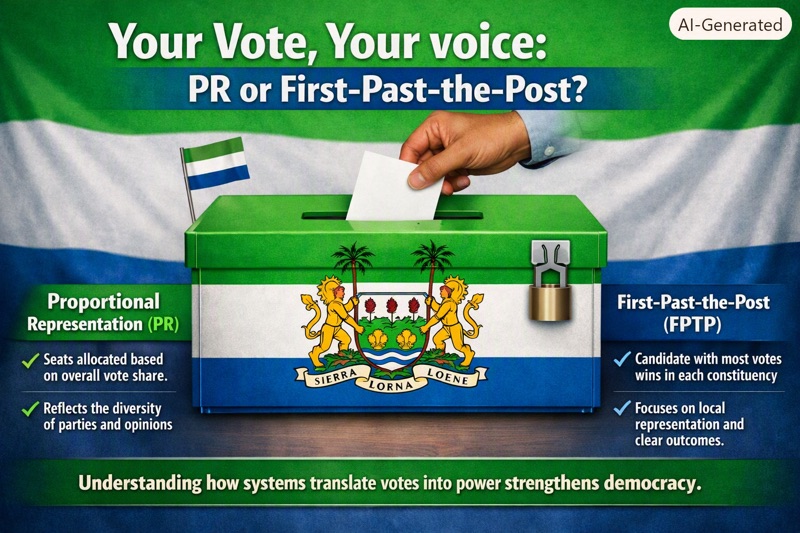
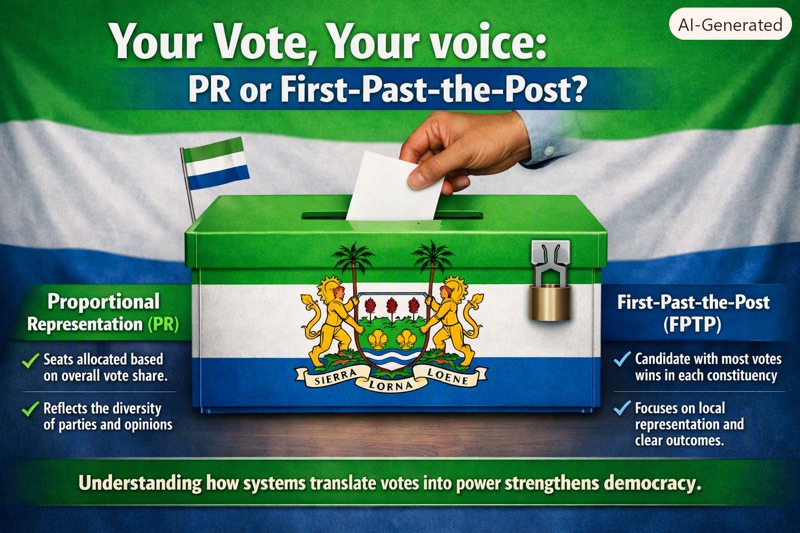
               YOUR VOTE, YOUR VOICE! 

                 ----------------------------------

                 Israel Ojekeh Parper Snr.  

  Blogger/Publisher/GOVERNANCE OBSERVER      


Saturday, 25 July 2026

Reconciliation or Accountability? The Constitutional Significance of the Discontinance of the case of the State Vs Ernest Bai Koroma, Former President of the Republic of Sierra Leone: A Veritable Executive Decision by the Arttorny General and Minister of Justice, Alpha Sesay Eaq.

When Law Meets Politics: The Koroma Case Discontinuance, Section 45 Criminal Procedure Act 2024 and Sierra Leone's Constitutional Crossroads.
[By Israel Ojekeh Parper Snr - 15th July 2026]


Abstract
This article examines the Attorney-General's discontinuance of criminal proceedings against former President Ernest Bai Koroma under Section 45 of the Criminal Procedure Act 2024. It explores the legal nature of nolle prosequi, the constitutional role of prosecutorial discretion, the distinction between discontinuance and acquittal, and the implications for accountability, reconciliation, political stability, and the rule of law.
     The High Court - Freetown Sierra Leone

Introduction

Sierra Leone's political and legal landscape experienced a significant development on 14 July 2026 when the Attorney-General and Minister of Justice formally discontinued the criminal proceedings against former President Dr. Ernest Bai Koroma under Section 45 of the Criminal Procedure Act, 2024. The decision brought an end to one of the most consequential prosecutions in the country's recent democratic history, a case arising from the failed coup attempt of November 2023 and involving allegations of treason and misprision of treason against a former Head of State. The Attorney-General's notice further confirmed that the proceedings were no longer before the courts, that Koroma's bail had ceased with immediate effect, and that he was free to return to Sierra Leone at a time of his choosing. 

The significance of this decision extends well beyond the fate of one individual. By invoking Section 45 of the Criminal Procedure Act 2024, identified as the provision under which the Attorney-General may enter a nolle prosequi, the government has reignited important debates concerning prosecutorial discretion, accountability, reconciliation, judicial independence, and the rule of law. [Parliament of Sierra Leone]

The constitutional questions raised by this decision are likely to remain long after the court file has been closed.

Understanding Section 45
The starting point is the law itself.
The Criminal Procedure Act 2024 identifies Section 45 under the heading: "Attorney-General and Minister of Justice may enter nolle prosequi." [Parliament of Sierra Leone]

The term nolle prosequi is derived from Latin and means, in essence, "we shall no longer prosecute." It is a long-established feature of the common law inherited by many Commonwealth jurisdictions.

A nolle prosequi does not amount to a conviction. Equally, it does not amount to an acquittal. This distinction is crucial.

The discontinuance of proceedings against former President Ernest Bai Koroma means that the State has elected not to continue the prosecution. It does not mean that a court has determined his innocence, nor does it mean that a court found the allegations proved. The matter has effectively been brought to an end through executive legal action rather than judicial determination.
In constitutional terms, the Attorney-General stopped the case; the court did not decide the case.
 Former President Ernest Bai Koroma

Neither Convicted Nor Acquitted
One of the most remarkable features of the Koroma matter is that it leaves behind no judicial verdict.
The public discourse surrounding criminal proceedings often focuses on only two outcomes: conviction or acquittal. However, prosecutorial discontinuance introduces a third category.

Former President Koroma now occupies a legal position in which: he has not been convicted; he has not been acquitted; but the proceedings have been terminated by the State.

For his supporters, the discontinuance will inevitably be interpreted as vindication. Many within the opposition All People's Congress (APC) are likely to argue that the collapse of the prosecution confirms longstanding concerns that the case was politically motivated.

For critics, however, the absence of a trial means that important questions regarding the allegations remain unresolved.
Both views derive from the same reality: the legal process did not run its full course.

Accountability Versus Reconciliation.
The most important debate arising from this decision concerns not criminal procedure, but constitutional philosophy.
At least three narratives are likely to emerge.

Narrative One: Reconciliation Has Triumphed
Supporters of the decision may argue that Sierra Leone has chosen stability over confrontation.
Treason proceedings against a former President carry enormous political consequences. Continuing such a prosecution could have prolonged partisan divisions and deepened tensions between the government and opposition.

Viewed through this lens, the Attorney-General's decision represents a conscious effort to promote national healing, political normalization and democratic coexistence.
Those who adopt this perspective will likely see the discontinuance as an exercise in constitutional statesmanship.

Narrative Two: Accountability Was Compromised
Others will take a different view.
They will argue that treason is among the gravest offences known to law and that allegations of such seriousness ought to be tested fully before an independent court.
From this perspective, discontinuing the proceedings leaves significant public questions unanswered.
Critics may ask:
If sufficient grounds existed to charge a former Head of State with treason, why was the case abandoned?
Conversely, if the case could not ultimately be sustained, why was it initiated?
These are legitimate questions in any democratic society committed to accountability.

Narrative Three: Constitutional Pragmatism
A third interpretation may ultimately prove the most persuasive.
Under this approach, the decision is seen neither as a surrender nor a vindication but as constitutional pragmatism. Parliament hah enacted a law which provides a lawful mechanism through section 45 (CPA 2024). The Attorney-General exercised that mechanism legally within his executive power.

The result may represent an attempt to balance competing constitutional values: accountability; stability; rule of law; national unity and public confidence. In young democracies and post-conflict societies, such balancing exercises are rarely straightforward.

The Rule of Law Question
The Koroma decision presents a fascinating challenge for rule-of-law analysis.
On one hand, the Attorney-General appears to have acted squarely within a statutory authority granted by Parliament. The decision therefore occurred within the framework of law rather than outside it. [Parliament of Sierra Leone]

On the other hand, the rule of law is about more than legality. It is also about public confidence, equality before the law, and consistency in the exercise of power.
The central constitutional question therefore becomes: Should the most politically consequential criminal prosecutions be resolved by prosecutorial discretion or by judicial determination? There is no universally accepted answer. Different Commonwealth democracies answer that question differently.
Yet it is precisely this tension that makes the Koroma matter constitutionally significant.

The Constitutional Implications.
Beyond its immediate legal and political consequences, the Koroma discontinuance raises important constitutional questions about the allocation of power within Sierra Leone's democratic system.

The first implication concerns the relationship between the Executive and the Judiciary. By invoking Section 45 to discontinue proceedings, the Attorney-General exercised an executive legal power that effectively brought an end to a case before the courts. The decision was lawful under the statutory framework identified in the Criminal Procedure Act 2024, yet it underscores the reality that not every major criminal controversy is ultimately resolved through judicial adjudication. [Parliament of Sierra Leone]

Second, the decision highlights the constitutional significance of prosecutorial discretion. In constitutional democracies, prosecutors do not merely enforce the law; they also make judgments concerning public interest, national stability, and the broader interests of justice. The Koroma matter demonstrates the immense influence that prosecutorial decisions can have on the political life of a nation.

Third, the case raises questions about accountability mechanisms. While the Attorney-General possesses legal authority to discontinue proceedings, citizens may legitimately ask whether such authority should be accompanied by stronger requirements for explanation, transparency, or parliamentary scrutiny in matters of exceptional public importance.

Finally, the decision contributes to an evolving constitutional conversation concerning the balance between law and politics. No constitutional democracy can completely separate the two. However, the legitimacy of constitutional institutions depends upon public confidence that legal powers are exercised fairly, consistently and in the national interest. The Koroma case therefore serves as an important reminder that constitutional authority derives not only from legal texts but also from public trust in those entrusted to exercise it.

Could the Case Return?
The discontinuance has understandably generated speculation about the future.
While the reported decision brings the current proceedings to an end, discontinuance is not the same thing as a judicial acquittal. Section 45 is identified as the statutory embodiment of the nolle prosequi power. [Parliament of Sierra Leone]


As a matter of traditional common-law understanding, a nolle prosequi does not ordinarily carry the same finality as an acquittal. However, the political reality may be more important than the legal theory.
Having discontinued such a high-profile prosecution, any future attempt to revive proceedings would raise inevitable questions:
What had changed? Why was the case abandoned only to be reopened? Would such action serve justice or revive political tensions? The result is that the political obstacles to reprosecution may be greater than the legal obstacles if that is ever contemplated.

What Does This Mean for the APC Party?
Politically, the immediate beneficiary of the decision is likely to be the APC.
The party can point to the fact that its former leader is no longer facing criminal proceedings and is free to return to Sierra Leone. [www.sierraleonemonitor.com]

However, the APC also faces a strategic choice. If it portrays the discontinuance as definitive proof of innocence, it risks overstating the legal consequences of the decision. Therefore, a more measured approach would be to present the development as a triumph of reconciliation and democratic dialogue rather than as a judicial exoneration. The APC Leadership may play it that way, but would the grass roots  support see it that way? However, such an approach may serve both the party and the nation better in the long run.

How might this affect opposition leaders generally?

My opinion is that opposition leaders across Sierra Leone will likely draw two very different lessons.

Positive lesson

They may conclude that the political system retains room for negotiation, accommodation, and reconciliation.

If a former President facing treason charges can ultimately see proceedings discontinued through a lawful constitutional process, opposition figures may perceive that political disputes need not end in permanent legal confrontation. This could reduce fears of politically explosive prosecutions.

Negative lesson

The opposite interpretation is also possible.

Some opposition party figures may think:

"If a prosecution can be commenced and later discontinued, it means we can still be exposed to major criminal proceedings based on political circumstances."

In that sense, the case may not eliminate fears of political prosecution; it may simply demonstrate that prosecution and discontinuance are both available tools within the political system.

Long-term effect

The real effect will depend on whether this becomes an isolated event or part of a broader pattern of political de-escalation.

Lessons for Sierra Leone's Constitutional Future.
Beyond the politics of the moment, this Ernest Bai Koroma case raises larger institutional questions.
Should future Attorneys-General be required to provide fuller and clearer reasons when discontinuing politically significant prosecutions?
Should Parliament exercise greater oversight over the use of prosecutorial discretion?
Should prosecutorial guidelines be published to enhance transparency and consistency?
Should Sierra Leone consider strengthening independent prosecutorial institutions, including the role of a Director of Public Prosecutions?

These questions are not criticisms of the decision itself. They are the natural questions that arise whenever constitutional powers of great consequence are exercised.

In addition to the above, the greatest significance of the Attorney-General's action may lie not in criminal law but in political signaling.

To the APC, it signals de-escalation. To the government, it may signal reconciliation. To civil society, it raises questions about balancing accountability and stability. To future Attorneys-General, it demonstrates the enormous constitutional weight carried by the Section 45 power of nolle prosequi. [Parliament of Sierra Leone]

And perhaps most importantly, the decision shifts Sierra Leone's national conversation away from whether Ernest Bai Koroma should stand trial and toward how the country manages political disagreements among major democratic actors. That may ultimately be the lasting historical significance of this episode.

Conclusion
The discontinuance of the treason proceedings against former President Ernest Bai Koroma will undoubtedly stand as one of the most consequential legal and political developments of 2026. Yet, its enduring significance may have little to do with the criminal allegations themselves.

The case has become a national conversation about the nature of constitutional power.
It has highlighted the distinction between prosecution and adjudication, between accountability and reconciliation, and between legal authority and political legitimacy.

Whether history ultimately judges the decision as an act of reconciliation, a compromise of accountability, or an example of constitutional pragmatism, one fact is beyond dispute: The discontinuance of Ernest Bai Korona's case  has transformed Section 45 of the Criminal Procedure Act 2024 from an obscure procedural provision into one of the most discussed constitutional powers in Sierra Leone today. [Parliament of Sierra Leone]

 (Hon Alpha Sesay: Attorney General and   Minister of Justice)
  

The greatest significance of the Attorney-General's action may lie not in criminal law but in political signaling.

To the APC, it signals de-escalation.

To the government, it may signal reconciliation.

To civil society, it raises questions about balancing accountability and stability.

To future Attorneys-General, it demonstrates the enormous constitutional weight carried by the Section 45 power of nolle prosequi. [Parliament of Sierra Leone]

Finally, this decision by the Attorney General and Minister of Jostice Hon Alpha Sesay to discontinue the Koroma treason and mis-prison of treason case, may ultimately be remembered not for determining guilt or innocence but for demonstrating the constitutional significance of prosecutorial discretion during moments of national political tension.

End:


   Author/Publisher: Israel Ojekeh Parper Snr
     14th July 2026

(Part 2 to follow)


SOME COMMENTARIES:

Click Link.
https://www.facebook.com/share/p/1H6ESnULQD/