The Thirty‑Year Constitutional Relay: How Generations of Failed Reviews Shaped the 2026 Reforms.
By Israel Ojekeh Parper Snr. 31/07/2026
The Thirty‑Year Constitutional Relay: How Generations of Failed Reviews Shaped the 2026 Reforms
Tracing the lineage from Strasser’s 1993 Advisory Council to the Tucker and Cowan Commissions — and how Alpha Sesay “cloned” three decades of consensus.
EXECUTIVE SUMMARY
Sierra Leone’s 2026 Constitutional Amendment Bill is the latest chapter in a thirty‑year relay of reform attempts, each one producing ideas but failing procedurally. From the 1993–1995 Strasser Advisory Council, through the 2008 Tucker CRC, the 2017 Cowan CRC, and the 2023 Tripartite Committee, successive governments generated a remarkably stable body of consensus on electoral calendars, executive removal rules, depoliticization of the armed forces, and proportional representation.
Attorney General Alpha Sesay’s 2026 draft did not invent new doctrine; it consolidated, cloned, and operationalized the accumulated consensus of three decades. His procedural innovation — abandoning the “total overhaul” model in favour of targeted parliamentary amendments — finally allowed Sierra Leone to
implement reforms that had been intellectually settled since the 1990s but politically blocked by referendum requirements, transitions of power, and institutional inertia.
Part II traces this lineage, showing how the 2026 reforms are not a rupture but the first successful harvest of Sierra Leone’s long‑standing constitutional aspirations.
INTRODUCTION: THE LONG ROAD TO REFORM! Why Sierra Leone Keeps Returning to the Same Constitutional Questions.
Constitutional reform in Sierra Leone has never been a single event; it is a recurring national conversation that re‑emerges every decade with strikingly similar conclusions. The country’s constitutional history reads less like a sequence of isolated commissions and more like a continuous intellectual project, repeatedly interrupted by political transitions, crises, and shifting priorities.
From the NPRC’s 1993 Advisory Council to the Cowan CRC’s nationwide consultations, Sierra Leone has produced thousands of pages of recommendations, hundreds of stakeholder submissions, and multiple draft constitutions — yet until 2026, almost none of these proposals crossed the threshold into law.
This section examines the historical relay that shaped the 2026 reforms:
• how the 1995 Working Draft introduced modern governance concepts;
• how the Tucker CRC refined them with post‑war institutional logic;
• how the Cowan CRC validated them through mass public consultation;
• and how the Tripartite Committee gave them bipartisan legitimacy.
By tracing this lineage, we see that the 2026 Amendment Bill is not a sudden innovation but the culmination of a thirty‑year constitutional conversation — one that finally found a procedural pathway to implementation.
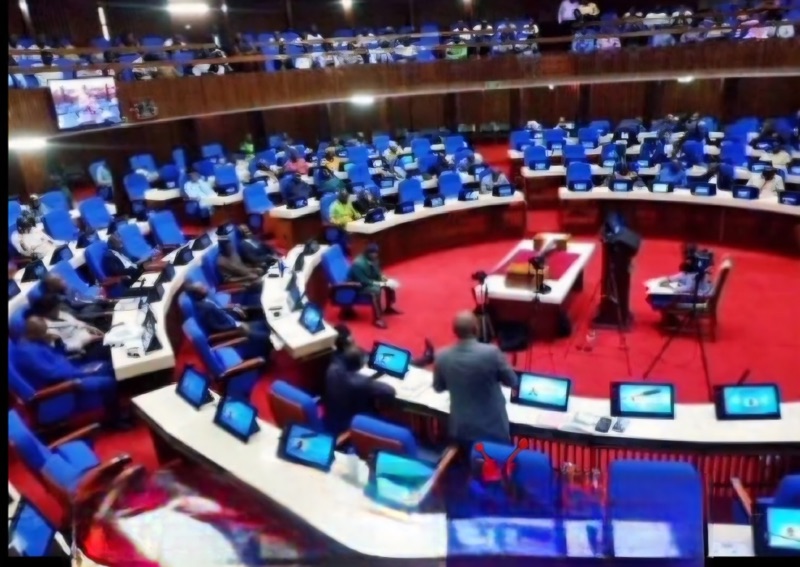
Sierra Leone’s House of Parliament
THE CHAIN OF HISTORICAL REVIEW EFFORTS (1993–2023)
Sierra Leone’s modern constitutional journey passes through four major milestones before the currently debated efforts:
1. Strasser/ NPRC Advisory Council (1993–1995)
Following the 1992 coup, Capt. Valentine Strasser appointed Dr. Ahmad Tejan Kabbah to chair a National Advisory Council which produced the 1995 Draft Working Contitution.
This 1995 Working Draft constitution -was never enacted, but it pioneered/introduced several modern debates such as:
• splitting the Attorney General from the Minister of Justice,
• demilitarisation politics and restricting military involvement in governance
• early proposals for fixed election dates,
• early proportional representation concepts e.g. District-based proportional representation (PR) experiments.
Although abandoned after the 1996 democratic elections, it created the first modern reform blueprint.
2. The Dr Peter Tucker Constitutional Review Commission (2007–2008)
Appointed by President Tejan Kabba after the TRC’s recommendations, Dr. Peter Tucker led a technical commission that:
• identified structural gaps in the 1991 Constitution text,
• proposed independent agency models,
• recommended fixed electoral calendars,
• highlighted entrenched clauses requiring referendum thresholds.
The report was submitted to the incoming Government in 2008 but the report was shelved due to political transition.
However, its technical precision later became the backbone of Justice Edmond Cowan’s (2013 - 2017) and the current Attorney General Alpha’s 2026 constitutional reviews.
3. Cowan Constitutional Review Committee (2013–2017)
President Ernest Bai Koroma launched an eighty (80) member plenary led by Justice Edmond Cowan. This was the largest civic consultation conducted in Sierra Leone’s history: it conducted over 10,000 public consultations nationwide, held about 133 stakeholder engagement; received back over 70,000 consultation forms, and 150 position papers were submitted.
The process culminated in a 2017 White Paper in which the government after scrutiny, rejected about 75% of recommendations, stalling the overhaul prior to the 2018 elections.
However, the Cowan CRC produced a very comprehensive consensus archive which has been found useful by the current AG in his drive towards constitutional reform.
4. Tripartite Committee (2023)
Following the disputed 2023 General elections, the Government and the All Peoples Congress (APC) party
formed a Tripartite Committee that produced 18 consensus recommendations, including:
district‑level PR mechanics, electoral calendar reforms, strengthened nomination processes for Electoral Commission and gender‑inclusive provisions.
This committee was supposed to provided the political legitimacy earlier reviews lacked, but there has been some arguments and disagreements at its implementation.
1991 vs 1993–1995: TWO PATHS TO MULTIPARTYISM.
A comparison of the 1990 - 1991 President J S Momoh transition and the 1993 / 1995 Captain Valentine Strasser/Tejan Kabba transition reveal two distinct constitutional paradigms:
Dimension. 1990-1991 1993-1995
Momoh. Strasser
Transition Transition
(Peter Tucker) (Tejan Kabba)
Originating Dejure Defacto
Authority Civilian MilitaryJunta
Govt.
One-party Junta-NPRC
state
Primary
Mechanism. Top-down Post coup
repeal of exit roadmap
1978 &
one-party Advisory
state Council
drafting
Public
Consent Enacted via By passed;
August 1991 1996
Public elections
Referendum held under
restored
1991
Constitution
text.
Core Focus.
Restoring Demilitarising
multiparty politics;
Political establishing
competition independent
under civilian agency
rule. models
These divergent origins explain why later commissions struggled: The 1991 Constitution headed by Dr Peter Tucker during President Momoh’s era, was born from a civilian referendum, while the 1995 draft by the Advisory Council headed by Tejan Kabba under NPRC,was born from a military exit strategy. Their DNA never aligned.
HOW ALPHA SESAY “CLONED” 30 YEARS OF CONSENSUS.
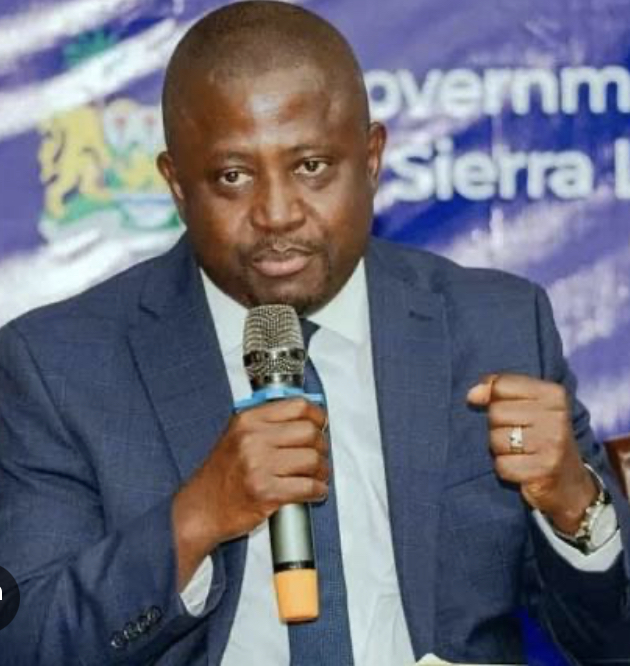
Attorney General Alpha Sesay rather than drafting new constitutional change concepts, adopted a strategic legislative harvesting process which he described in Parliament as “nothing invented in my office.” He as Attorney General has presented a government proposal to Parliament after systematically extracted, consolidated and re packaged thirty (30) tress of accumulated public and expert consensus. Every major provision in the 2026 Bill is a direct extraction from earlier national processes: a CUT AND PASTE EXERCISE!
TH CLONED LEGISLATIVE LINEAGE INCLUDES:
• Executive removal rules — lifted from Cowan (2017) which analysed the 2015 Sam‑Sumana crisis and proposed a clearer (VP) removal procedures;
• Fixed election schedules — first drafted in the 1995 Working Constitution Draft refined by Peter Tucker in 2008 and re-endorsed by Cowan in 2017.
• Depoliticisation of armed services — traces its exact phrasing from TRC Report (2004) and the Peter Tucker CRC in 2008.
• District PR mechanics —derived from the 1995 Advisory Council of Tejan Kabba and the 2023 Tripartite Committee recommendations. As true to his words the A G (Alpha Sesay) “Nothing was invented in [his] office “!
THE MISSING PIECE AND PROCEDURAL BREAKTHROUGH AFTER 30 YEARS FAILURE
The most important insight is procedural, not substantive. But why earlier reform efforts failed?
Earlier efforts failed because previous approaches were attempts in total constitutional overhaul, requiring referendum thresholds and political alignment that never materialised. For instance: 1995: No referendum; military exit overshadowed intended reforms. In 2008: Political transition from Tejan Kabba to Ernest Bai Koroma but the Tucker laid frozen and in 2017, government rejected 75% of Cowan’s recommendations. The 2018 - 2023 attempt met with electoral disputes which consumed the political bandwidth and also, Entrenched clauses required referendum thresholds the government avoided for economic and other reasons.
The current Attorney General Alpha Sesay’s innovation: A procedural hack: instead of attempting a total overhaul (which requires a referendum) Sesay:
• extracted non‑entrenched consensus provisions,
• package them into targeted parliamentary amendments,
• avoided referendum deadlock, and
• implemented reforms early enough for 2028 electoral timelines. This point he repeated a number of of times in his presentation in Parliament.
This procedural shift is considered a strategic breakthrough of the 2026 reforms.
CONCLUSION
The Philosophy of Continuity: Why should the 2026 Reformers Succeed Where Other Past Efforts Failed?
Constitutional reform is often imagined as rupture — a decisive break from the past. Sierra Leone’s experience suggests the opposite: durable reform emerges not from rapture, but from continuity.
If the 2026 Amendment Bill succeeds (partisanship aside) it will be because it does not attempt to reinvent the constitutional order. Instead, A.G. Alpha Sesay appears to have capitalised and treated the past three decades of review efforts as a repository of assumed national wisdom, and brinksmanship, accumulated through military transitions, democratic restorations, peace building processes, and electoral negotiations.
The deeper philosophical lesson is that constitutional change in Sierra Leone has always been conceptually easy but procedurally hard. The country has long agreed on the core reforms. What it lacked is a mechanism capable of translating consensus into law without triggering political deadlock or referendum paralysis; and it appears that A. G. Alpha Sesay’s approach of incremental amendments rather than total overhaul of the constitution, cunningly embodies such pragmatic philosophy that will encourage legislators/reformers to follow the path of least resistance, and not the path of greatest ambition. This rather is his recognition that constitutions evolve through accumulation, not revolution; through harvesting, not invention.
The questions now are : Would the 2026 reforms mark a turning point in Sierra Leone’s constitutional journey and do these reforms if passed into law demonstrate that Sierra Leone’s constitutional future will be built not by discarding the past, but by finally implementing the past’s most enduring ideas for the benefit of her citizens?
If the answers to these questions are in the affirmative, then the 2026 reforms will be a turning point as they will demonstrate that Sierra Leone’s constitutional future will no longer be built by discarding the past, but by implementing the past’s most enduring ideas; and that country’s constitutional journey is not a story of repeated failures, but of long-term coherence - a relay in which each generation carries forward the same baton until one finally crosses the finish line.
Let’s look to the future as Parliament continues debating the 2026 Constitutional Reform Bill.
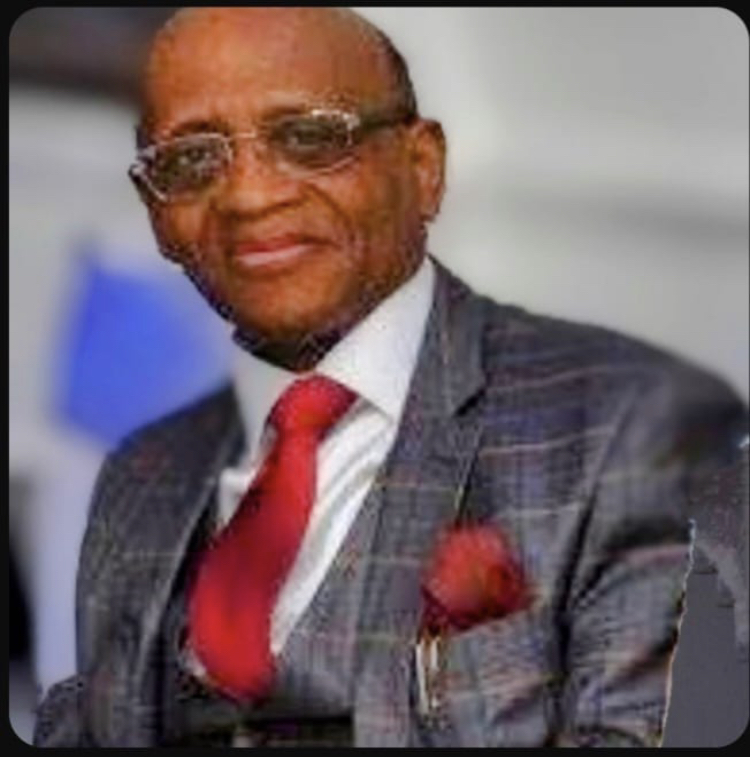
Author: Israel Ojekeh Parper Snr
Blogger/Publisher - Governance Observer
————————————-
LATEST ON CONSTITUTIONAL AMENDMENTS
🏛️🇸🇱 SIERRA LEONE'S 1991 CONSTITUTION AMENDED: PARLIAMENT APPROVES MAJOR ELECTORAL REFORMS
On 28th July 2026, Sierra Leone's Parliament passed significant amendments to the 1991 Constitution, introducing some of the most far-reaching electoral and governance reforms in the country's democratic history. These changes are expected to shape how future elections are conducted and how key public offices are filled.
Here are some of the major constitutional amendments approved by Parliament:
🗳️ 1. Presidential Election Threshold
Previously, a presidential candidate was required to secure 55% of the valid votes cast to be declared the winner. Under the new amendment, the threshold has been changed to 50% plus one vote (50% + 1).
📌 Example: If 100 valid votes are cast, a candidate must receive at least 51 votes to win outright.
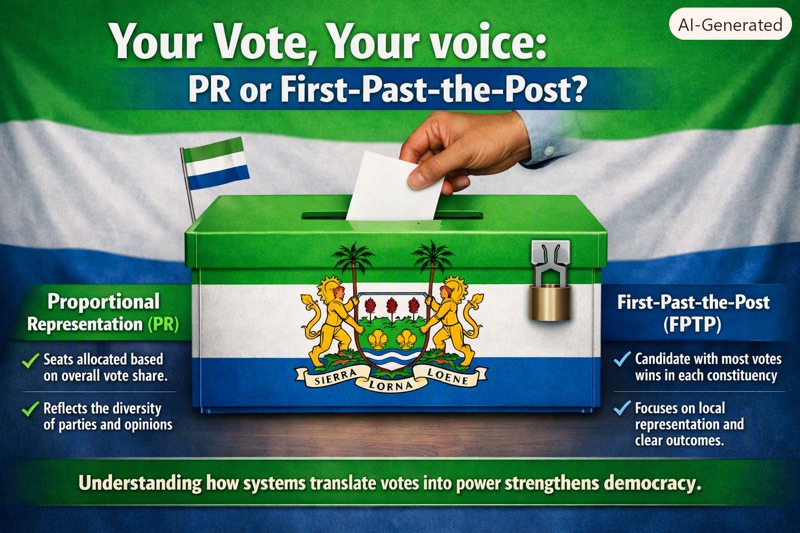
🗳️ 2. Electoral System Changed to Proportional Representation (PR)
Parliament has approved the Proportional Representation (PR) electoral system, replacing the previous constituency-based system for the elections covered by the amendment. This marks a significant shift in Sierra Leone's electoral framework.
⚖️ 3. Removal of the President or Vice-President
Previously, the removal of a Vice-President could occur following dismissal from their political party and subsequent action by the President. The amended law now provides that the President or Vice-President can only be removed through a two-thirds majority vote in Parliament, strengthening parliamentary oversight.
🗳️ 4. Appointment of the Chief Electoral Commissioner
Under the previous system, the President appointed the Chief Electoral Commissioner after consultations with political parties and stakeholders. The new amendment establishes a Search and Nomination Committee, appointed by the President, to identify and recommend qualified candidates for the position.
📅 5. Fixed Date for General Elections
Instead of the President setting the election date, Sierra Leone will now have a fixed election date.
🗓️ General elections will be held on the second Saturday of November in every election year.
👩🏽⚖️ 6. Women's Representation
To promote gender inclusion, every registered political party must now ensure at least 30% representation of women among its parliamentary candidates.
🏛️ 7. Independent Presidential and Vice-Presidential Candidates
For the first time, independent (non-partisan) candidates who meet the legal requirements may contest for the offices of President and Vice-President.
📋 8. Resignation of Public Servants
Previously, public officers seeking elective office had to resign 12 months before an election. The amended Constitution reduces this period to 6 months before becoming eligible to contest.
⚖️ 9. Election Petition Timeline
The deadline for filing an election petition has been shortened from 7 days after the declaration of results to 3 days, encouraging a faster resolution of electoral disputes.
🌍 10. Dual Citizenship and Public Office
The Constitution has also revised the rules regarding dual citizens. Rather than imposing a blanket restriction, the amendment introduces specific conditions under which dual citizens may qualify to contest for public office.
🇸🇱 These constitutional amendments represent a landmark moment in Sierra Leone's democratic evolution and are expected to influence future elections, governance, and political participation across the country.
💬 What are your thoughts on these constitutional reforms?
🤔 Which amendment do you believe will have the greatest impact on Sierra Leone's democracy?
📢 Share your views respectfully in the comments, and don't forget to Like 👍, Comment 💬, and Share 🔄 to keep the conversation going.