SIERRA LEONE CONSTITUTIONAL LAW & ELECTORAL ARCHITECTURE FOCUS: 1991–2026 REFORMS.
Executive Summary
This report examines Sierra Leone’s proposed 2026 constitutional reforms through three lenses: the bill’s legislative content, its historical roots in earlier review processes, and its implications for proportional representation. The central question is whether the bill offers a pragmatic route to near-term electoral and administrative reforms, or offers a long-term democratic value depending on how transparently entrenched constitutional questions—especially executive power, judicial independence, rights protections, and election management—are addressed in a future referendum process.
An in-depth analysis of the proposed constitutional overhaul, political party posturing, and the controversial procedural split between entrenched and non-entrenched

Sierra Leone stands at a pivotal constitutional crossroads as Attorney General and Minister of Justice, Alpha Sesay, pilots the 2026 Constitutional Amendment Bill through Parliament. Originating from decades of post-conflict governance consultations—including the 1999 Lomé Peace Accord, the Truth and Reconciliation Commission (TRC), the 2017 Cowan Constitutional Review Committee (CRC) Report, and the recent post-2023 election Cross-Party Tripartite Committee—this bill represents the most ambitious attempt to modernize Sierra Leone's electoral and administrative framework since the restoration of multi-party democracy.
Anatomy of the 2026 Amendment Bill
The proposed legislation concentrates on recalibrating state institutions, codifying electoral rules, and mitigating institutional friction during transition cycles. The core provisions include:
• Fixed General Election Schedule: Establishes a permanent voting date on the second Saturday of November every fifth year, stripping the executive of the power to manipulate election timing for tactical advantage.
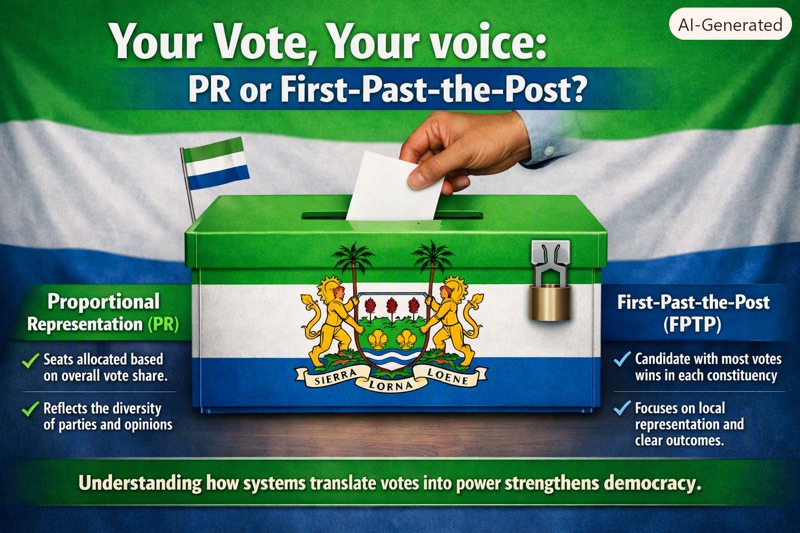
• Proportional Representation (PR) Codification: Institutionalizes the District Block PR system into the constitution to eliminate frequent, costly, and politically volatile localized by-elections.
• Presidential Threshold Adjustment: Adjusts the winning threshold for presidential elections from 55% to 50% + 1 vote, while introducing a geographic requirement requiring candidates to secure at least 20% of votes in two-thirds of voting districts to ensure a genuine nationwide mandate.
• Depoliticisation of Security Forces: Explicitly prohibits the Sierra Leone Police (SLP) and the Republic of Sierra Leone Armed Forces (RSLAF) from participating in partisan activities or promoting party interests.
• PPRC Party Deregistration Powers: Empowers the Political Parties Regulation Commission (PPRC) to deregister any political party that fails to secure a seat at either local or national levels across two consecutive general elections.
• Executive Membership Protection: Clarifies that a sitting President or Vice President cannot be stripped of executive office purely on the grounds of losing party membership or being expelled by party leadership - resolving a major constitutional ambiguity exposed during the 2015 Sam-Sumana crisis.
The Parliamentary Battlefield: SLPP vs. APC
The debate inside the Chamber reflects deep-seated political divisions. The ruling Sierra Leone People’s Party (SLPP) frames the bill as an essential, non-partisan modernisation package that lowers the administrative cost of democracy and enforces cross-party consensus reached during the Tripartite Committee deliberations. The government explicitly rejects the opposition fears of an executive power grab, emphasising that no third-term extensions are contemplated.
Conversely, the opposition All Peoples Congress (APC) maintains a stance of high scrutiny. The APC insists that any constitutional amendment must strictly reflect all 80 recommendations of the Tripartite Committee without selective omissions. Furthermore, opposition MPs express alarm over the PPRC's proposed deregistration powers, warning that regulatory oversight could be weaponised against opposition coalitions or emerging third parties. The APC also demands that the proposed Independent Search and Nomination Committee for Electoral Commissioners be insulated from executive influence to guarantee total commission neutrality.
CIVIL SOCIETY & MEDIA REACTION
Civil Society Organizations (CSOs) and the Sierra Leone Association of Journalists (SLAJ) have welcomed the fixed election dates and security neutrality clauses. SLAJ, however, expressed concern that standalone press freedom protections were omitted from the non-entrenched text. On gender equality, rights groups have strongly backed the bill's mandatory 30% quota for women in parliament and local councils sees this as a landmark victory for inclusive governance.
The Split: Entrenched vs. Non-Entrenched Clauses
A central point of debate is the AG Alpha Sesay’s strategic decision to split the constitutional review into two distinct procedural tracks: non-entrenched clauses (which require a two-thirds parliamentary vote under Section 108) and entrenched clauses (which require a national referendum).
Dangers of Postponing Entrenched Clauses:
While passing non-entrenched administrative fixes appears to provide immediate electoral clarity, indefinitely shelving entrenched clauses would likely create structural risks. Leaving executive appointing powers, judicial independence mechanics, and fundamental human rights unreviewed while tightening operational electoral rules, risks creating an asymmetric system where the executive retains imperial powers while the while operational playing field is strictly constrained.
Two notable points:
1. Reaffirmation of Democratic Limits:
The Minister of Information Chernor Bah and AG Alpha Sesay publicly reaffirmed that President Julius Maada Bio has explicitly ruled out any "third-term" presidential agenda, reassuring the public that the 2026 bill focuses strictly on non-entrenched electoral mechanics and national cohesion.
2. The "Search and Nomination Committee" Test Case: Civil society organizations (such as ILRAJ) have been actively scrutinizing executive appointments to the Electoral Commission (ECSL), calling on Parliament to enact the bill's proposed independent framework swiftly to eliminate political interference in commissioner appointments.


Israel Ojekeh Parper Snr.
Blogger/Publisher/GOVERNANCE OBSERVER

No comments:
Post a Comment